Checking account...Please wait.
Broken Down Truck: Driver's Safety and Recovery Guide - Expert insights and guidance for truck operators. Learn maintenance strategies, repair options, and cost management from FRAQ Solutions.


A broken down truck is defined as a commercial vehicle that has suffered a mechanical failure severe enough to prevent safe continued operation on public roads. The industry term is "commercial vehicle breakdown," and it covers everything from a blown tire on a loaded flatbed to a seized engine on a Class 8 semi. Every minute you spend reacting incorrectly after a truck breakdown raises your risk of a secondary collision, cargo loss, or a costly engine rebuild. This guide gives you the exact sequence to follow: secure the scene, diagnose the problem, call the right help, and protect your load and your logbook.
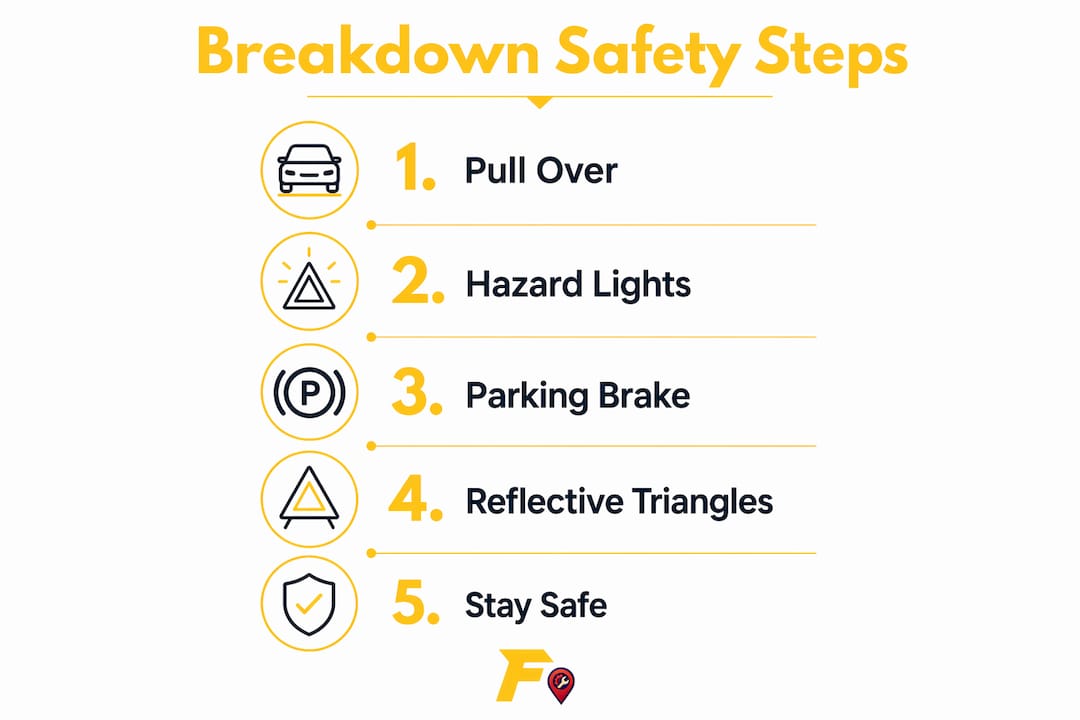
Secondary collisions after breakdowns are a major hazard. The first 15 minutes after a truck broke down are the most dangerous period on the road. Your first job is not to diagnose the problem. Your first job is to get the truck off the travel lane and make it visible.
Pull as far right as possible onto the shoulder or an emergency pull-off area. If you cannot reach the shoulder, aim for an exit ramp, a rest area, or a wide median. Never stop in a travel lane unless the truck physically cannot move another foot.

Turn on your four-way flashers the moment you feel trouble. Once stopped, set the parking brake before you do anything else. These two actions take less than five seconds and immediately reduce rear-end collision risk.
Triangles must be placed at 10 feet, 100 feet, and 200 feet behind the truck. On hills or curves, extend the rearmost triangle to 500 feet. Federal guidelines require you to complete this within 10 minutes of stopping.
Pro Tip: Carry a bright safety vest in your cab door pocket. Put it on before you open the door. Drivers who exit without high-visibility gear are at serious risk from passing traffic.
On busy highways, stay inside the cab with your seatbelt fastened until help arrives. Exit only when traffic conditions are safe and you have a clear path away from the travel lane. If you do exit, move to the guardrail side, not the traffic side.
Your emergency kit should include:
Knowing what broke down helps you describe the issue accurately to a dispatcher or mobile diesel mechanic. A clear description cuts response time and gets you the right technician on the first call.
Watch for these warning signs before the breakdown becomes catastrophic:
Shutting down the engine immediately when you observe any of these signs prevents a roadside fix from turning into a full in-frame engine rebuild. That distinction can mean the difference between a $500 repair and a $25,000 overhaul.
"Ignoring early warning signs is the single most expensive mistake a driver can make. A rising temp gauge or a knocking engine is the truck telling you to stop. Drivers who listen save their engines. Drivers who push through lose them."
Once stopped safely, you can perform a quick visual check from outside the truck:
Pro Tip: Never open a radiator cap on a hot engine. Wait at least 30 minutes after shutdown before checking coolant levels. A pressurized cap can release scalding steam instantly.
Proactive attention to minor warning signs greatly reduces downtime and repair costs compared to ignoring early signals. A driver who catches a slow coolant leak during a pre-trip inspection avoids the same breakdown entirely.
Calling the wrong tow truck for a semi truck breakdown is a costly mistake. Standard towing services lack the equipment and training to safely move a loaded Class 8 truck. You need a certified heavy-duty recovery operator with flat-tow capability or a heavy-haul lowboy trailer.
Before you call, have this information ready:
The drivetrain must be isolated during towing. Flat tows on heavy-haul lowboy trailers preserve mechanical integrity and prevent expensive secondary damage to the transmission and axles. A standard wrecker dragging a semi on its drive wheels can destroy a transmission in under a mile.
Service typeBest forKey requirementMobile diesel mechanicEngine, electrical, fuel system repairsTruck accessible on shoulder or lotHeavy-duty tow recoveryDisabled trucks that cannot moveCertified heavy-recovery operatorTire service truckBlown steer, drive, or trailer tiresCorrect tire size in stockReefer repair technicianRefrigerated trailer unit failuresCertified reefer technician on call
Pro Tip: Save the numbers for at least two heavy-duty tow operators in every state you regularly run. Pre-vetting them before a semi truck breakdown means you are not searching reviews from the shoulder of I-40 at 2:00 AM.
Fraqsolutions connects drivers directly to verified mobile diesel mechanics and heavy-duty tow operators across the United States, without a middleman or commission markup.
A semi truck broke down situation does not end when the tow truck arrives. You still have freight to protect, a logbook to manage, and a dispatcher waiting for answers.
Extended downtime requires securing loaded trailers in monitored yards with surveillance to prevent cargo theft and protect your insurance position. Do not leave a loaded trailer unattended on a highway shoulder overnight.
Steps to protect your freight:
Under 49 CFR 395.1(b)(1), a breakdown qualifies as an adverse driving condition. This allows a driving window extension of up to 2 hours beyond the standard 11-hour limit to reach the nearest safe location. This exemption does not reset your 14-hour clock. It only extends the driving time window.
Accurate documentation of breakdown time, service call time, and technician arrival is critical for insurance claims and avoiding detention penalties. Use your phone to capture:
Most states will tow or ticket trucks parked on interstate shoulders after 24–48 hours. Shoulders are for emergencies only. If repairs are complex, arrange a tow to a repair facility promptly. Waiting too long turns a breakdown into a towing bill plus a citation.
A broken down truck requires immediate safety action, accurate diagnosis, and the right professional help to minimize downtime and financial loss.
PointDetailsSafety comes firstDeploy reflective triangles within 10 minutes at 10, 100, and 200 feet behind the truck.Shut down earlyStop the engine immediately at any sign of overheating, oil pressure loss, or knocking.Call the right towOnly certified heavy-duty operators with lowboy trailers should move a disabled semi.Document everythingTime-stamped photos and call logs protect you in insurance claims and detention disputes.Know your HOS rightsA breakdown qualifies under 49 CFR 395.1(b)(1) for up to a 2-hour driving extension.
Most drivers treat a breakdown as a failure. I see it differently. A breakdown is almost always the result of a warning sign that got ignored for one trip too many. The knocking noise that started three days ago. The temp gauge that crept up on the last climb. The slow tire leak that "wasn't that bad yet." The truck was communicating. The driver was busy.
Building a local emergency vendor list and pre-vetting recovery crews before you need them is the single highest-return preparation a driver or owner-operator can make. It costs nothing but an hour of research. It saves hours of panicked searching from a dark shoulder at midnight.
The drivers I have seen recover fastest from a semi truck breakdown share one habit: they treat their pre-trip inspection as a diagnostic, not a checkbox. They know what their truck sounds like when it is healthy. So when something changes, they catch it early. That habit alone separates a $400 repair from a $15,000 engine replacement.
Fraqsolutions was built around this reality. The platform exists because drivers should not have to scramble for help when they are already stressed. Having a verified service network in your pocket before you need it is the practical version of preparedness. Use it before the breakdown, not after.
— FRAQ
When a truck breakdown hits, every minute of delay costs money and risks your cargo. Fraqsolutions connects drivers directly to 24/7 semi truck repair services, mobile diesel mechanics, tire repair crews, and heavy-duty tow operators across the United States.
The Fraqsolutions platform and FRAQ Network App give you real-time access to verified service providers near your location, with no middlemen and no commission fees. Drivers can search by service type, location, and availability. Whether you need a diesel mechanic on the shoulder of I-10 or a 24/7 trailer repair shop in Memphis, Fraqsolutions has the network to get you moving again. Set up your driver dashboard before your next run so help is one tap away when you need it.
A broken down truck is a commercial vehicle that has suffered a mechanical failure preventing safe continued operation. The industry term is "commercial vehicle breakdown," covering engine failures, tire blowouts, electrical faults, and drivetrain failures.
Pull to the shoulder immediately, activate hazard lights, set the parking brake, and deploy reflective triangles within 10 minutes at 10, 100, and 200 feet behind the truck. On busy highways, stay inside the cab with your seatbelt fastened until conditions are safe to exit.
Shut down the engine immediately if you observe a rising temperature gauge, zero oil pressure, engine knocking, or thick smoke. Continuing to run the engine under these conditions can turn a minor repair into a full engine rebuild.
Yes. Under 49 CFR 395.1(b)(1), a breakdown qualifies as an adverse driving condition, allowing up to a 2-hour extension beyond the standard 11-hour driving limit to reach the nearest safe location. This does not reset your 14-hour clock.
Standard tow trucks lack the equipment and training to safely move a loaded Class 8 truck. Only certified heavy-duty operators using flat-tow methods or heavy-haul lowboy trailers can move a semi without damaging the drivetrain and transmission.